
What Is a Weighted Rice Purity Test? (And How It Scores Differently)

The weighted rice purity test assigns different point values to each question based on how significant the experience is — unlike the standard test, where every “yes” subtracts one point equally. So losing your first kiss and committing a felony do not cost you the same. They shouldn’t. The weighted version accounts for that.
If you’ve taken the original and wondered why cheating once feels the same as a misdemeanor arrest when you tally up your score — that’s exactly the problem the weighted format was built to fix.
What Is the Standard Rice Purity Test, and Why Does It Have a Problem?
Rice University students in Houston, Texas created the original purity test sometime in the 1980s as a freshman orientation bonding exercise. The Rice Thresher, the university’s student newspaper, distributed it as a self-assessment — 100 questions, one point per question, subtract the number of “yes” answers from 100 to get your score.
The scoring logic was always blunt. Every experience carries identical weight, which made sense as a social icebreaker — nobody was trying to build a psychometric instrument. But once the test escaped campus and landed on Reddit, Tumblr, and eventually TikTok (where it went viral among Gen Z around 2023), people started taking the score more seriously than the original format deserved.
That created a real distortion. A student who has tried alcohol once and one who has been arrested for a DUI finish at the same numerical distance from 100. That’s not meaningfully different scoring — it’s just counting.
How Does the Weighted Rice Purity Test Actually Work?
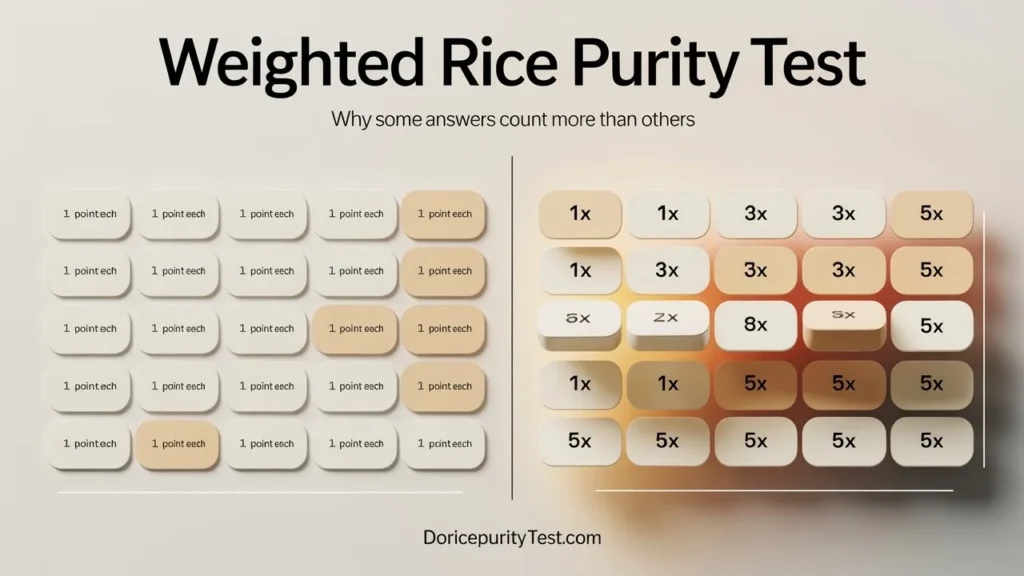
The weighted rice purity test assigns a multiplier — typically between 1 and 5 — to each of the 100 questions, scaled by the perceived social, legal, or relational significance of the experience.
Minor experiences like holding hands or staying out past curfew might carry a weight of 1. More significant milestones — sexual activity, drug use, legal trouble — are assigned weights of 3 to 5. Your final score is calculated by subtracting the sum of your weighted points from a higher baseline (often 500, in a 5-point-maximum system) rather than from 100.
The result is a score that actually differentiates between levels of experience. Two people with identical standard scores of 72 can land at very different places on the weighted scale — which is a more accurate reflection of what their answers actually represent.
Weighted vs. Standard Rice Purity Test: What Changes in Practice?
| Feature | Standard Test | Weighted Test |
|---|---|---|
| Total questions | 100 | 100 |
| Points per question | 1 (flat) | 1–5 (scaled by significance) |
| Score baseline | 100 | 500 (or custom) |
| Differentiates severity | No | Yes |
| Original format | Yes (Rice University, 1980s) | No (community-developed variation) |
| Best use case | Social bonding, casual self-reflection | Comparative analysis, nuanced scoring |
| Score interpretation | Higher = less experienced | Higher = less experienced (same direction) |
The weighted version preserves the same logic — higher score means fewer notable experiences — but the gaps between scores become meaningful rather than arbitrary.
What Scores Mean on the Weighted Rice Purity Test
Because weighting systems vary across different versions (there is no single official weighted test — several community-developed variants exist on Reddit and dedicated quiz platforms), exact score ranges differ. But the general interpretation follows a similar pattern across most versions.
Scores in the top 20% of the weighted scale indicate genuinely limited exposure to the categories the test covers. Mid-range scores reflect a mixed profile — some significant experiences, many not. Lower scores reflect a broad range of experiences across legal, social, sexual, and substance-related categories.
The critical difference from the standard test: two people with nearly identical weighted scores are actually more comparable than two people with identical standard scores. That’s the entire point of the format.
Why the Weighted Version Is More Honest (And Where It Still Falls Short)
The weighted rice purity test does something the original genuinely cannot — it stops treating a first kiss and a criminal charge as equivalent data points. For anyone using the test to actually understand something about their own experience profile rather than just as a game, that matters.
What it still cannot do: the weighting values themselves are subjective. Who decided that question 47 is worth 3 points and question 52 is worth 5? Usually, whoever built that particular version of the test. The Rice Thresher’s original format had no weighted system — everything community-developed since then reflects the values of whoever designed it, not any external standard.
That’s not a fatal flaw. It’s just honest context. The weighted test is a more refined social instrument. It is not a clinical assessment.
Is the Weighted Rice Purity Test Official?
No. Rice University produced one version of the purity test — the flat 100-point format that has circulated since the 1980s. No weighted version has been officially published by the university or the Rice Thresher.
Every weighted rice purity test in circulation is a community-developed variation. Some have been built by developers on GitHub. Others appear on quiz platforms with varying degrees of care in how they assigned the weights. If you’re comparing your weighted score to someone else’s, confirm you’re both using the same version — the numbers are not cross-compatible across different weighted variants.
How to Interpret Your Weighted Rice Purity Test Score
The same general framework that applies to the standard test applies here, just with more granularity. A high weighted score (close to the maximum, whatever that is in your version) means most of your answers were “no.” A low score means a high concentration of significant “yes” answers.
What actually matters: the weighted test gives you a better tool for self-reflection than the flat version, but it still only measures what it measures — a specific list of 100 experiences, written decades ago, originally for college freshmen at a single university in Houston. Your score is a data point, not a verdict.
The weighted format makes that data point more accurate. It does not make it more important.
FAQs
What Is a Weighted Rice Purity Test?
A weighted rice purity test is a modified version of the original 100-question self-assessment where each question carries a different point value based on the significance of the experience. Instead of subtracting one point per “yes,” you subtract a scaled value — typically 1 to 5 — so more significant experiences reduce your score more than minor ones do.
How Is the Weighted Rice Purity Test Different From the Regular One?
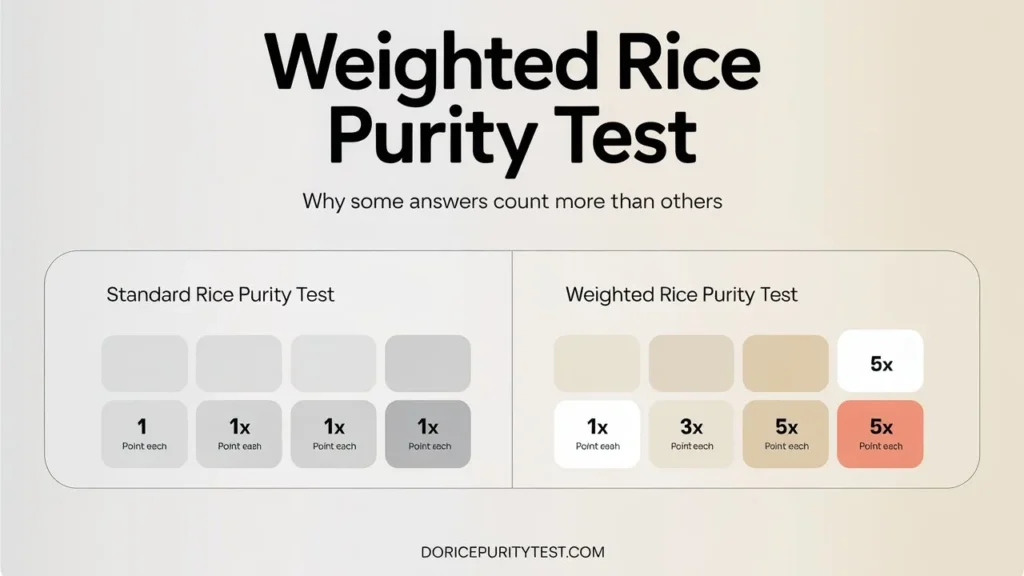
The standard rice purity test subtracts one point for every “yes” answer, treating all 100 experiences as equally significant. The weighted version assigns different multipliers to each question, meaning serious experiences like legal trouble or sexual activity cost more points than minor milestones like holding hands or skipping class.
What Is a Good Score on the Weighted Rice Purity Test?
Since weighting systems vary across community-built versions, there is no universal benchmark. In a 500-point system, scores above 400 generally indicate limited experience with the test’s categories. Scores between 250 and 400 reflect a mixed profile. Below 250 suggests exposure across most of the test’s major categories.
Who Created the Weighted Rice Purity Test?
Rice University created the original flat-scoring purity test in the 1980s. No weighted version was officially created by the university. All weighted variants are community-developed — built by individuals on Reddit, GitHub, and quiz platforms who wanted a more nuanced scoring system than the original provided.
Is the Weighted Rice Purity Test More Accurate Than the Original?
More accurate in the sense that it differentiates between levels of experience — yes. More accurate as a psychological or clinical instrument — no. The weighting values reflect whoever built that particular version, not any validated methodology. It’s a better social tool, not a scientific one.
Can I Compare My Weighted Score to My Friend’s Standard Score?
No. The two formats use different baselines and scoring systems. A 72 on the standard test and a 360 on a 500-point weighted test are not directly comparable. To compare scores meaningfully, both people need to use the same version of the same test.
Why Does the Weighted Version Give Different Results for the Same Answers?
Because not every “yes” costs the same amount. On a weighted test, answering yes to a low-significance question might subtract 1 point. Answering yes to a high-significance question might subtract 5. Two people with the same total number of “yes” answers can finish with very different weighted scores depending on which questions they said yes to.
Does the Weighted Rice Purity Test Ask Different Questions?
Usually not. Most weighted versions use the same 100 questions as the original rice purity test — they only change the point value assigned to each answer. Some custom versions add or modify questions, but the core question set is typically preserved.
Where Can I Take the Weighted Rice Purity Test?
Several quiz platforms and independent developer sites host weighted versions. Since there is no single official weighted test, results vary by platform. Search for “weighted rice purity test” and confirm the site explains its scoring methodology before treating the result as comparable to another platform’s version.
Is a Lower Weighted Rice Purity Score Bad?
No. The test was originally designed as a bonding activity for Rice University freshmen — not as a moral judgment. A low score means you’ve had more of the experiences on the list. That’s a description, not an evaluation. The weighted format makes the scoring more precise, but it doesn’t change what the number actually means.
Conclusion
The weighted rice purity test solves a real problem with the original format — it stops pretending that every experience on that list is equally significant. The result is a score that actually reflects something meaningful about the distribution of your answers, not just the raw count of “yes” responses.
Whether that precision matters to you depends entirely on why you’re taking it. As a game with friends, the original works fine. As a tool for genuine self-reflection, the weighted version gives you something more honest to work with.


